
Dry coolers
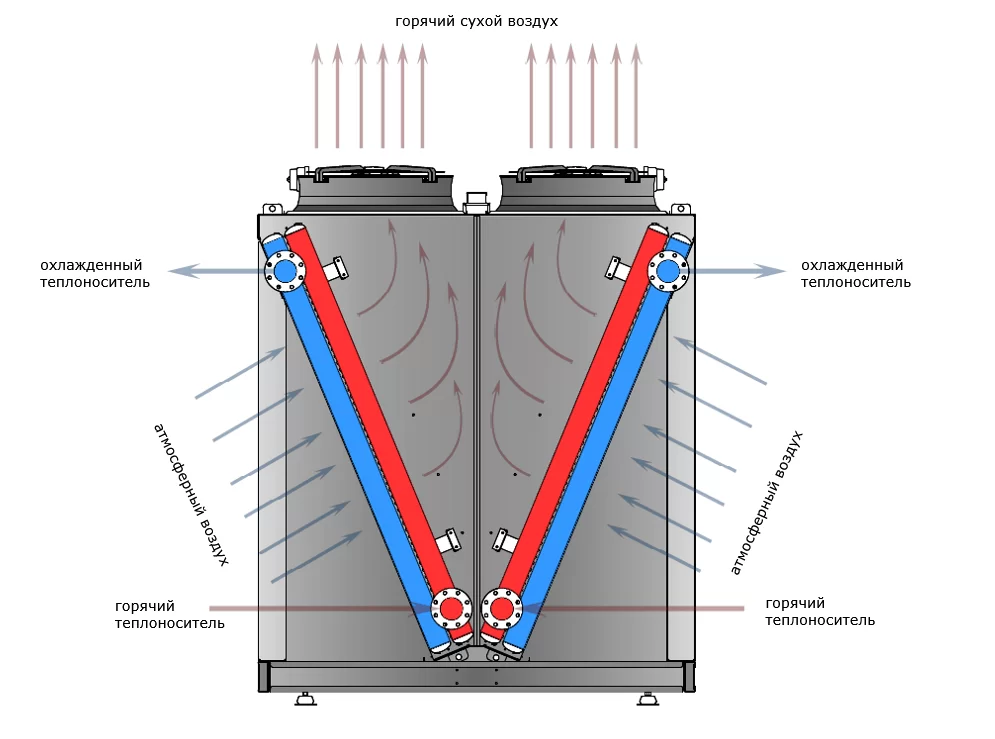
A dry cooler operates on the principle of utilizing natural cold. The coolant, which can be water or ethylene/propylene glycol, is cooled by low-temperature ambient air. Air is drawn through the heat exchanger by axial fans. The refrigerant circulates in a closed loop and typically cools industrial equipment.
When can a dry cooler be used?
- If the coolant outlet temperature is 3-6 °C higher than the ambient temperature. Otherwise, heat exchange and cooling will not occur.
- If ethylene/propylene glycol is used as the coolant, it allows the dry cooler to be used in winter.
- If the coolant needs to be cooled in a closed loop without interaction with the environment.
Technical Specifications of the Device
| Body material | galvanized steel, magnelis, stainless steel | Minimum medium flow rate, m3 / h | 1 |
| Heat exchange tube diameter, mm | 12, 15 | Cooling capacity | from 15 kW to 5 MW |
| Lamella material | aluminum, AlMg alloy | Heat exchange surface area, m2 | up to 9900 |
| Maximum outlet air temperature, °C | 60 | Internal tube volume, dm3 | up to 1600 |
| Working pressure in tubes, bar | 9.5 | Pipeline connection | flange (GOST, DIN) |
| Device length, m | 1 - 13 | Estimated service life, years | 20 |
| Fan diameter, mm | 500, 600, 800, 910 | Warranty, year | 1 |
| Fin spacing | 2.1, 2.2, 2.5 |
Standard Dry Cooler Equipment
The dry cooler design consists of three main elements: a manifold, fans, and the heat exchanger housing, which integrates everything into a single structure.
Standard components:
- Heat exchange block: a bundle of copper tubes and aluminum lamellas;
- Set of axial fans from ebm-papst or Ziehl-Abegg;
- Set of service keys;
- Support tube technology to compensate for thermal expansion during operation and distribute the load between the heat exchanger and housing;
- Sensor bracket on the manifold;
- Galvanized housing.
Additional Dry Cooler Assembly Options
In addition to the standard configuration, there are additional options that can extend the device's lifespan.
- Thermoflow offers control panels to regulate the device's operation:
- Step-by-step regulation;
- Frequency regulation;
- Frequency regulation with sine filters;
- For EC fans.
The control panel ensures efficient fan operation by distributing the load among them during partial load hours.
When ambient temperature exceeds the required cooling design temperature, adiabatic spray systems can be used. There are three types of spray systems: direct spray, Ecomash panels, and PED panels. The spray system operates by evaporating water in front of the heat exchanger. Spray nozzles create a mist of fine droplets.
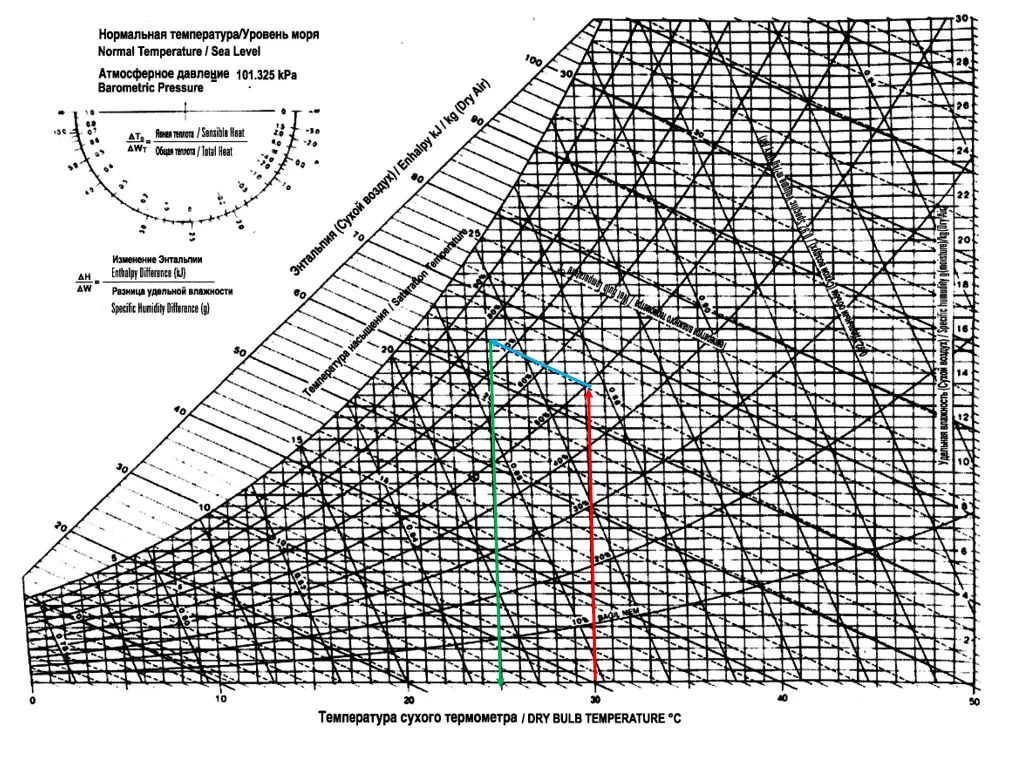
The interaction of water and air saturates the air with moisture and cools it. For example, at 30 °C air temperature and 50% relative humidity, adiabatic cooling can saturate the air to 85% and achieve 25 °C.
- Dry coolers with spray systems can use coated lamellas for additional corrosion protection. Thermoflow uses several types of coatings, differing in properties and cost: Blygold, AlMg, epoxy coating.
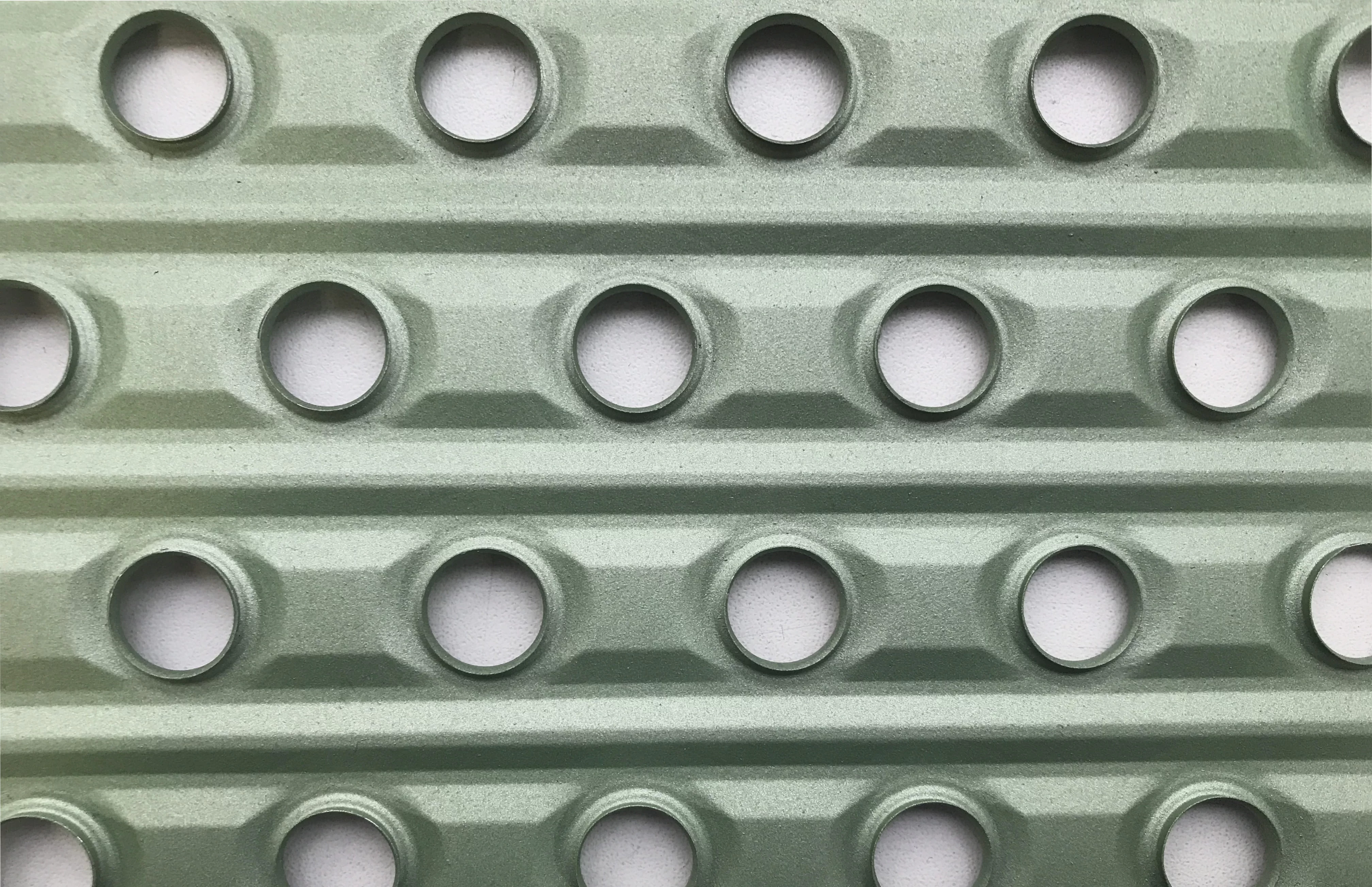


Lamellas with protective coatings - You can also order additional terminal boxes, vibration dampers, pump groups, or install EC fans.
- If needed, the device can be made with AISI 316 steel tubes and AlMg3 alloy lamellas.
- Our company collaborates with trusted partners for design work based on long-term cooperation.
- Installation and commissioning services are provided either in-house or through third-party organizations.
Advantages of Dry Coolers
This type of device offers several advantages, primarily because it allows free use of natural cold:
The main advantage is operational savings.
Below is a brief example of the technical and economic feasibility of using a dry cooler instead of a chiller.
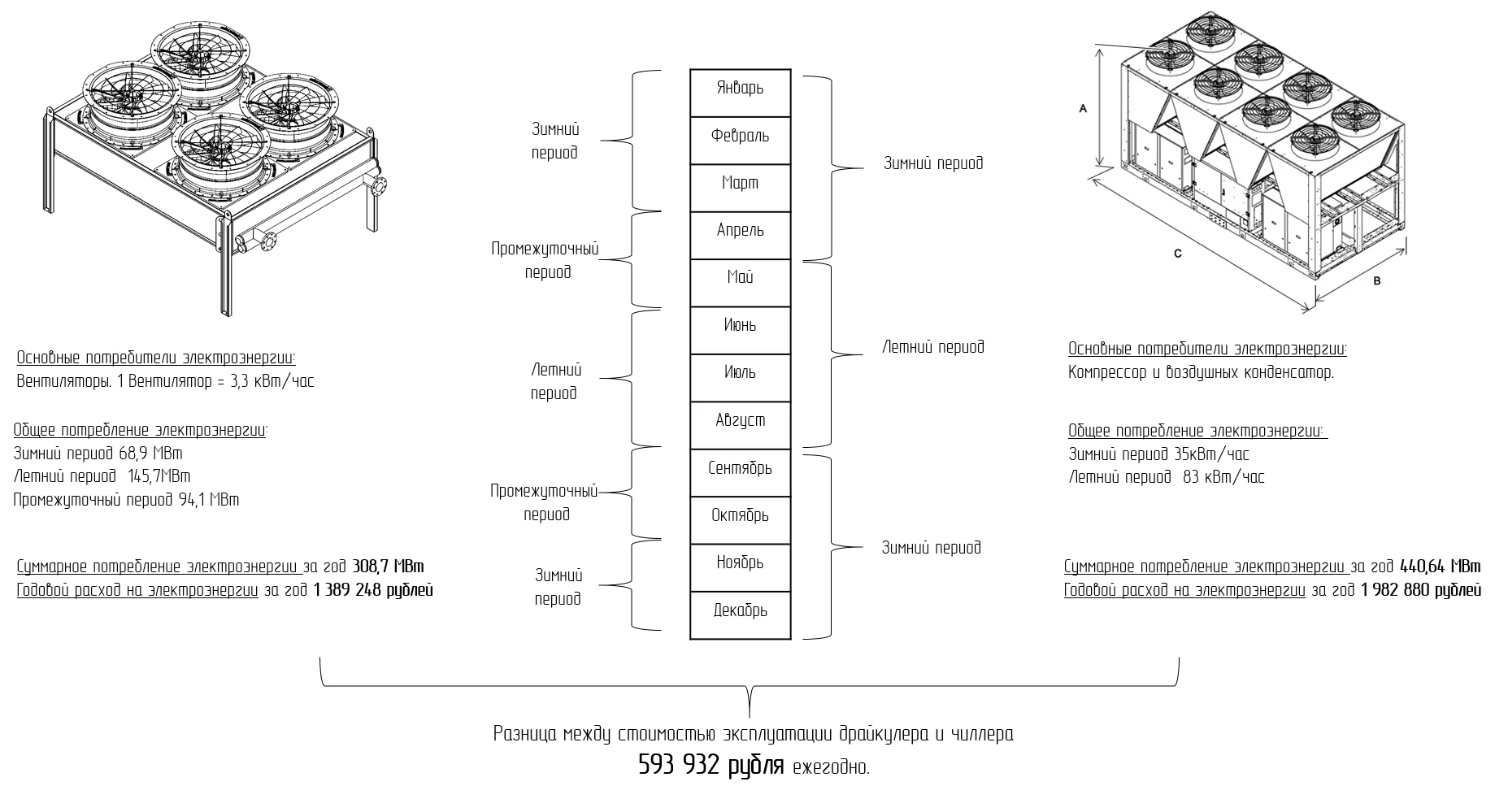
Assume the electricity cost at the facility is 4.5 rubles/kWh. A manufacturing plant operates a chiller year-round. The chiller has two power-consuming components: the compressor and air condenser. Total power consumption is 35 kWh in winter (unloaded mode) and 83 kWh in summer (loaded mode). Winter operation lasts 8 months, summer — 4 months. Annual electricity consumption will be 440.64 MWh, costing 1,982,880 rubles.
In a dry cooler, only the fans consume power. One fan uses 3.3 kWh. For a fair comparison, assume 20 fans. The dry cooler operates in three modes: winter, summer, and intermediate. For the Moscow region, winter lasts 174 days (temperature below 6 °C), summer — 92 days (above 16 °C), and intermediate — 99 days (6–16 °C). Fan load varies with ambient conditions: 5 fans in winter, 12 in intermediate, and 20 in summer. Annual electricity consumption will be 308.72 MWh, costing 1,389,248 rubles.
Thus, the difference in operational costs between a dry cooler and chiller is 593,932 rubles/year. When choosing between replacing an existing chiller or purchasing a dry cooler, note the dry cooler's payback period is 3 years.
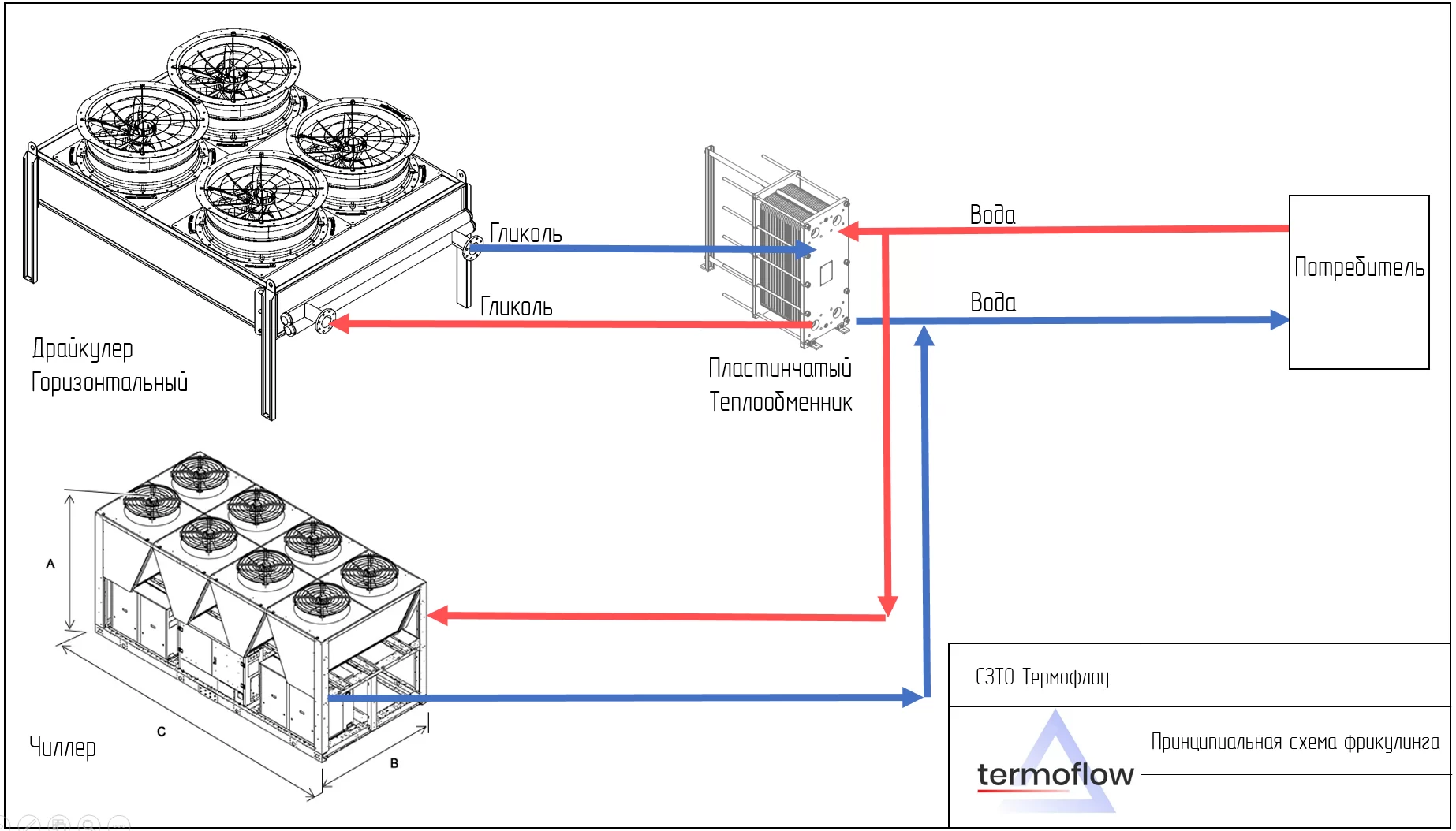
Maximum savings are achieved by combining air coolers and chillers in a free cooling system. The chiller operates in summer, and the dry cooler in winter and intermediate seasons. Running a chiller year-round consumes significantly more power than this hybrid approach.
- Minimal maintenance due to few moving parts.
- Closed-loop system prevents coolant contamination or evaporation.
Disadvantages of Dry Coolers
The main limitation is that they cannot cool below ambient temperature. Adiabatic cooling can help but only by 5–6 °C. For example, to cool water from 25 °C to 20 °C at 25 °C ambient, a chiller or free cooling system with a dry cooler below 15 °C is preferable.
How to Choose a Dry Cooler
To select equipment, determine the following initial dаta:
The required cooling tower capacity is calculated by:
Q=G∙C p ∙(t out -t in )
Q – heat flow (heat to be dissipated, kW)
t in – coolant inlet temperature from the process (°C)
t out – coolant outlet temperature for the process (°C)
G – coolant mass flow rate (kg/h)
C p – coolant specific heat at average temperature (kJ/kg·K)
Coolant type: ethylene/propylene glycol, water.
Ambient temperature: determined per SNiP or customer specifications for installation.
Related images
Call Us or Request a Callback
(+90) 543 176 09 64 (+90) 530 942 82 2024/7 Active